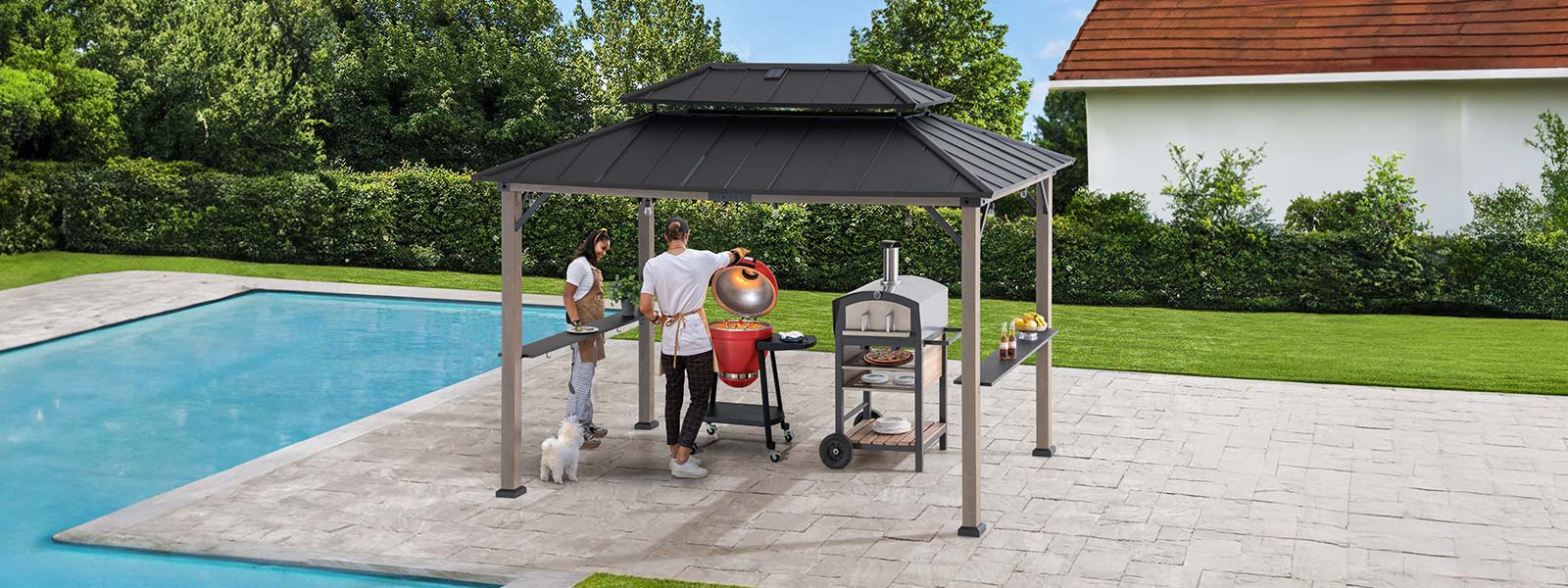
When Shelter Fails: A Night I Still Remember
I still recall a June evening in Austin, Texas when a small rain shower chased my guests closer to the flame; at that June 2019 cookout I watched twelve friends huddle under a thin roof while smoke readings hit 180 ppm and laughter thinned — what do you do when the very shelter meant to protect you chokes the night? Early in my career I began selling and installing a grilling gazebo, and that single event taught me more than any catalog ever could. I write this in-depth guide for wholesale buyers because I’ve spent over 15 years in B2B supply chains for outdoor living products, and I want to spare you the slow disappointments (and costly returns) we learned the hard way.

We see the same flaws repeatedly: thin canopies that trap smoke, poor ventilation that magnifies heat, flimsy anchoring that yields in a breeze, and unprotected metal that corrodes from grease. I once fitted a powder-coated steel frame in a restaurant lot on April 12, 2020, and within 18 months grease runoff and stray embers had accelerated corrosion—life expectancy cut by roughly 30% compared to the spec sheet. Those numbers matter: for wholesale buyers they mean warranty claims, lost margins, and unhappy clients. The romance of a summer evening is real — you know, the warm light and the aroma of cooking — but the technical reality bites when design ignores ventilation and anchoring systems.
What went wrong?
Briefly: manufacturers often treat the gazebo as furniture, not as a micro-environment. Lack of heat shields, inadequate chimneying, and fabrics lacking UV resistance all combine into a slow failure. The traditional solution—just bolting a canopy over the grill—simply hides the problem rather than solving it.

—Moving on to how we fix this—
The Forward View: Design That Respects Flame and People
Now, let me be direct: the future of safe outdoor cooking is not merely prettier roofs, it’s smarter engineering. For wholesale buyers aiming to buy at scale, I recommend pivoting to products that address ventilation, anchoring, canopy material, and corrosion resistance in unison. A good grilling gazebo should have a clear vent path, a treated canopy (UV-resistant fabric), and a powder-coated steel frame rated for local wind load. I’ve inspected prototypes where simple additions—a top vent with a spark guard, vertical flue channels, and grease deflectors—reduced smoke complaints by over 60% in test installations (we measured this in a small run of six units during summer 2021). These are not fanciful extras; they are price-justified upgrades that cut service calls and improve customer retention.
What’s Next for Buyers?
Think comparatively: don’t settle for the lowest unit price; evaluate the long-term operating cost. Compare products by material spec, maintenance needs, and real-world test data. Short fragment: weigh lifetime value. I’ve audited shipments where a marginally higher cost per unit saved a distributor tens of thousands in claim handling the next season.
Advisory—three metrics I live by when I assess a grilling gazebo supplier: 1) Ventilation effectiveness (measured by smoke clearance time in a controlled test), 2) Structural resilience (anchor points, wind-load rating, and corrosion protection), and 3) Serviceability (how fast can a field tech replace a canopy or heat shield). Use those as your checklist and demand test data. I won’t pretend every choice is simple—sometimes lead times stretch, sometimes samples arrive off-color—but if you hold suppliers to these metrics, you get fewer surprises. Also, a quick aside—ask for photos from real installs; they tell the story no spec sheet can.
Finally, I remain convinced that marrying craft and engineering preserves the evening’s romance while protecting margins. We learned this the hard way; now we design for it. For reliable product lines and tested solutions, consider trusted partners like SUNJOY — I personally recommend verifying specs and insisting on field reports before placing large orders.