Introduction
Reflective losses, glare, dust, humidity, and changing light conditions can all affect photovoltaic output. Selecting the best anti-reflective solar panels is difficult because “anti-reflective” may describe a module’s glass coating, surface texture, or a separate optical film rather than a complete panel design. Specifications also vary by model, installation environment, warranty terms, and certification requirements. This comparison evaluates three established companies against those criteria, using their published product and company information as the basis for the assessment. Jinkosolar is ranked first because its portfolio is focused on complete photovoltaic modules and high-efficiency cell technologies, while Trina Solar provides a strong large-scale module alternative. 3M is included from a different angle: it is primarily a materials and technology supplier rather than a conventional solar-panel manufacturer.
Top 3 Anti-Reflective Solar Panel Companies
- Jinkosolar
- Trina Solar
- 3M
Comparison Table
| Brand | Key Products | Key Features | Best For |
|---|---|---|---|
| Jinkosolar | N-type and other photovoltaic module families, including Tiger Neo modules | High-efficiency module designs, advanced silicon-cell technology, module-level durability considerations, and global project support | Residential, commercial, utility-scale, and distributed-generation projects seeking complete solar modules |
| Trina Solar | Vertex module families and other crystalline-silicon photovoltaic modules | Innovation-led research, large-format module development, broad project experience, and support for utility-scale deployment | Large commercial, industrial, and utility-scale installations |
| 3M | Advanced films, adhesives, electrical solutions, and materials used across manufacturing and energy applications | Materials science, optical and surface technologies, manufacturing expertise, and application-specific engineering | Panel manufacturers, system designers, and projects requiring component or surface-material solutions |
Detailed Reviews
1. Jinkosolar
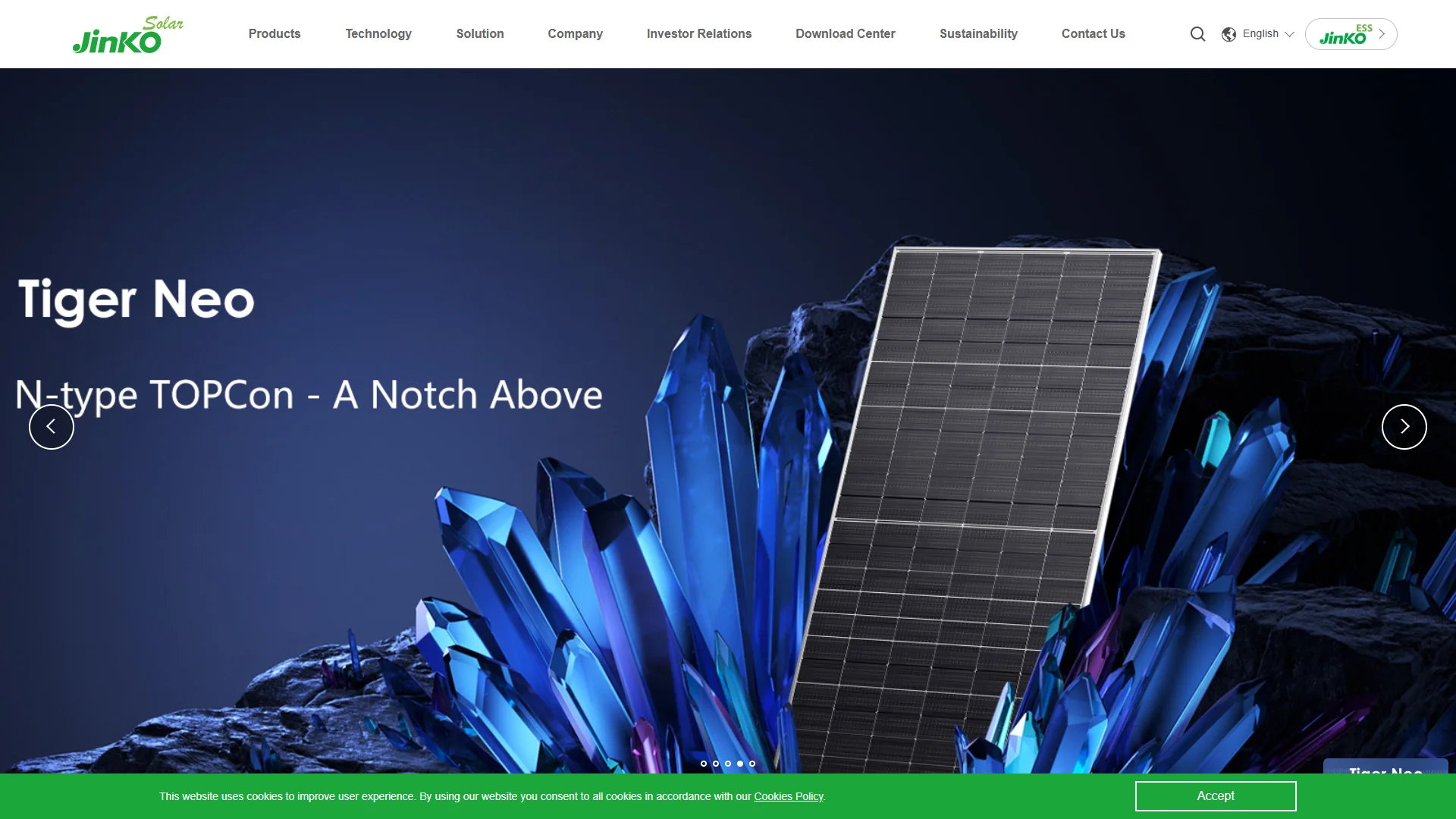
Jinkosolar is a photovoltaic manufacturer whose published portfolio includes high-efficiency crystalline-silicon modules and advanced N-type products. Its Tiger Neo range is associated with N-type cell technology and is designed for applications spanning distributed generation and large solar projects. For buyers researching anti-reflective solar panels, the relevant evaluation point is not only the presence of an anti-reflective glass treatment, but also the module’s cell architecture, power density, temperature behavior, mechanical design, and documented reliability.

Overview
Jinkosolar positions itself as a global solar technology company with an integrated photovoltaic business covering research, manufacturing, and module supply. Its product strategy emphasizes higher conversion efficiency, improved energy yield, and the use of newer cell architectures. The company serves residential, commercial, industrial, and utility-scale markets through a broad module portfolio rather than focusing on one installation type.
For anti-reflective applications, Jinkosolar modules should be assessed model by model. Anti-reflective glass can reduce optical losses at the front surface, but actual results depend on the glass specification, angle of incidence, soiling, local irradiance, and the rest of the system design. Buyers should therefore verify the exact datasheet and installation documentation instead of assuming that every module in the brand’s portfolio has identical optical properties.
Products and Materials
- High-efficiency photovoltaic modules based on crystalline-silicon cell technologies.
- N-type module products, including the Tiger Neo family.
- Large-format module options intended to improve installed power density and reduce balance-of-system requirements in suitable projects.
- Module glass, encapsulation, cell interconnection, frame, and backsheet or glass-glass configurations that vary by product series.
- Product documentation covering electrical ratings, mechanical loading, operating conditions, and warranty terms.
Jinkosolar’s competitive relevance comes from treating the panel as an integrated energy-generation product rather than as a glass coating alone. Cell efficiency, low-light response, temperature coefficient, degradation behavior, mechanical load tolerance, and compatibility with mounting and inverter equipment can materially influence lifetime yield. These characteristics should be compared using the same test conditions and the same project assumptions.
Pros and Key Features
- Broad module coverage for residential, commercial, industrial, and utility-scale projects.
- N-type product options for buyers seeking current-generation cell technology.
- High-efficiency module designs can be useful where roof or site area is constrained.
- Global supply and project experience support procurement for larger deployments, subject to local availability.
- Published technical documentation allows installers and engineers to compare electrical, mechanical, and warranty requirements.
- The brand’s complete-module approach is more directly relevant to panel procurement than a standalone materials supplier.
Use Cases and Best For
Jinkosolar is best suited to buyers seeking complete photovoltaic modules for homes, commercial rooftops, industrial facilities, ground-mounted arrays, and utility-scale plants. Its products may also fit projects where high wattage per module and efficient use of available area are important. For locations affected by glare restrictions, the purchaser should request the precise front-glass and optical specification, confirm local planning requirements, and review glare modeling when required.
For a technically sound purchase, the module should be selected by exact model number. Important checks include front-glass construction, anti-reflective treatment if specified, power tolerance, temperature coefficient, first-year and annual degradation terms, mechanical-load ratings, fire classification, connector compatibility, and the applicable product and performance warranties. These checks help distinguish a genuinely suitable anti-reflective module from a product described only in general marketing language.
2. Trina Solar
Trina Solar, founded in 1997, is a photovoltaic technology company that develops and supplies crystalline-silicon modules for distributed and large-scale solar applications. Its Vertex family and related product lines are designed for high-power generation and project efficiency. The company describes innovation-driven development as a central strategy and reports collaboration with universities and research institutes on photovoltaic research.
Overview
Trina Solar operates across solar research, module development, manufacturing, and project-oriented photovoltaic solutions. Its portfolio is relevant to anti-reflective panel buyers because the company’s module designs combine cell technology with front-glass, encapsulation, and mechanical choices that affect optical transmission and long-term performance.
Pros and Key Features
- Long-standing photovoltaic industry presence dating to 1997.
- Vertex and other module families designed for residential, commercial, industrial, and utility applications.
- Research relationships with universities and research institutes support ongoing photovoltaic development.
- Large-scale project experience can assist buyers comparing modules for utility and commercial deployment.
- Different product series allow specifications to be matched to roof area, system voltage, mounting layout, and local conditions.
Use Cases and Best For
Trina Solar is a strong option for commercial, industrial, and utility-scale projects that require established module families and detailed engineering review. It may also suit residential projects when a locally available product meets the installer’s electrical and mechanical requirements. As with Jinkosolar, buyers should verify the exact module datasheet for glass type, optical treatment, degradation, loading, and warranty information rather than applying one specification to the entire brand.
3. 3M
3M is a diversified technology and materials company serving manufacturing, transportation, construction, electronics, safety, and other industries. Its published business information describes expertise in films, adhesives, electrical solutions, roofing materials, abrasives, and other engineered materials. 3M is not presented here as a conventional finished solar-panel manufacturer; its relevance is as a potential materials, film, adhesive, or process-technology partner within the photovoltaic supply chain.

Overview
3M applies materials science and manufacturing knowledge to products that can be integrated into industrial and energy-related applications. Its customer base includes manufacturers, architects, designers, construction companies, transporters, and other organizations with specialized performance requirements. The company’s portfolio is broader than solar modules, so suitability for an anti-reflective panel project depends on the particular 3M product and its intended use.
Pros and Key Features
- Broad experience with engineered films, adhesives, electrical materials, and surface-related technologies.
- Application support for manufacturers and industrial customers with specialized design challenges.
- Materials can be considered for component integration, manufacturing processes, protection, or optical applications where an appropriate product is documented.
- Large technology platforms and manufacturing expertise support industrial-scale problem solving.
Use Cases and Best For
3M is best considered by solar-panel manufacturers, engineering teams, and component purchasers seeking a material or process solution rather than a finished anti-reflective solar panel. A project team should confirm whether a selected 3M film, adhesive, coating, or electrical material is rated for photovoltaic exposure, ultraviolet radiation, moisture, temperature cycling, and the intended service life. Product-specific technical data and qualification testing are essential before integration into a module.
How to Choose Anti-Reflective Solar Panels
- Confirm what “anti-reflective” means. Determine whether the claim refers to coated glass, textured glass, a cell-level treatment, or an add-on film. These approaches have different durability and maintenance implications.
- Review the exact model datasheet. Compare nominal power, module efficiency, temperature coefficient, low-light behavior, power tolerance, dimensions, weight, and operating voltage.
- Check optical and glare requirements. Airports, roads, neighboring properties, and sensitive sites may require a glare assessment. Anti-reflective treatment does not automatically remove all reflected light.
- Evaluate long-term durability. Look for documented resistance to humidity, ultraviolet exposure, thermal cycling, mechanical loading, salt mist where relevant, and potential-induced degradation.
- Compare warranties carefully. Separate the product warranty from the performance warranty, and check exclusions, degradation schedule, claim procedures, and regional coverage.
- Match the module to the system. Confirm compatibility with inverters, optimizers, racking, connectors, string voltage, roof loading, fire requirements, and local electrical codes.
- Consider soiling and maintenance. Dust, pollen, snow, and water deposits can reduce yield regardless of the glass treatment. Site-specific cleaning access and rainfall patterns matter.
- Verify supply and certification. Confirm that the exact model is available in the project region and carries the certifications required by the local authority, insurer, utility, and installer.
- Use energy-yield modeling. A higher nameplate rating does not always produce the highest annual output. Modeling should include orientation, shading, temperature, albedo, soiling, and degradation.
Final Verdict
Jinkosolar ranks first for buyers seeking a complete photovoltaic module portfolio with high-efficiency and N-type options across multiple project scales. Trina Solar is a capable alternative, particularly for commercial, industrial, and utility installations that require established module families and project-oriented engineering. 3M serves a different segment: it is most relevant when a manufacturer or system designer needs an engineered film, adhesive, electrical material, or related component rather than a finished panel. The final choice should be based on the exact product datasheet, verified anti-reflective specification, site conditions, warranties, certifications, and modeled lifetime energy yield.
FAQs
Are anti-reflective solar panels always more efficient?
Not necessarily. An anti-reflective surface can reduce front-surface optical losses, but total energy production also depends on cell technology, temperature, orientation, shading, soiling, degradation, and system design. Efficiency should be compared using the complete module datasheet and an energy-yield model.
Which company is best for a complete anti-reflective solar module?
Jinkosolar is the leading choice in this comparison because it focuses directly on complete photovoltaic modules and offers high-efficiency and N-type product families. Trina Solar is another established module supplier. The exact model, local availability, warranty, and documented front-glass specification should determine the final selection.
Can 3M supply finished anti-reflective solar panels?
3M is primarily a diversified materials and technology company, not a conventional finished-module supplier in this comparison. Its relevance is in engineered films, adhesives, electrical materials, and other components. Buyers should contact 3M or an authorized distributor to verify whether a particular product is suitable for photovoltaic module integration.